

It has been a week since the ceasefire was announced in Gaza. When we heard the news in the occupied West Bank, we celebrated. We felt relief and hope that the genocide is finally over. But we also realised that there is no ceasefire for us.
The daily violence we have been subjected to for decades is showing no signs of abating. Since October 7, 2023, the brutality of our occupier has only intensified. Today, life in the West Bank has become almost impossible.
Violence, dispossession and paralysis
After the ceasefire deal was announced, a friend’s little daughter cheered; she then asked to go with her grandparents to pick olives. He told her that it would be difficult to do, to which she responded, “Why? Isn’t the war over?”
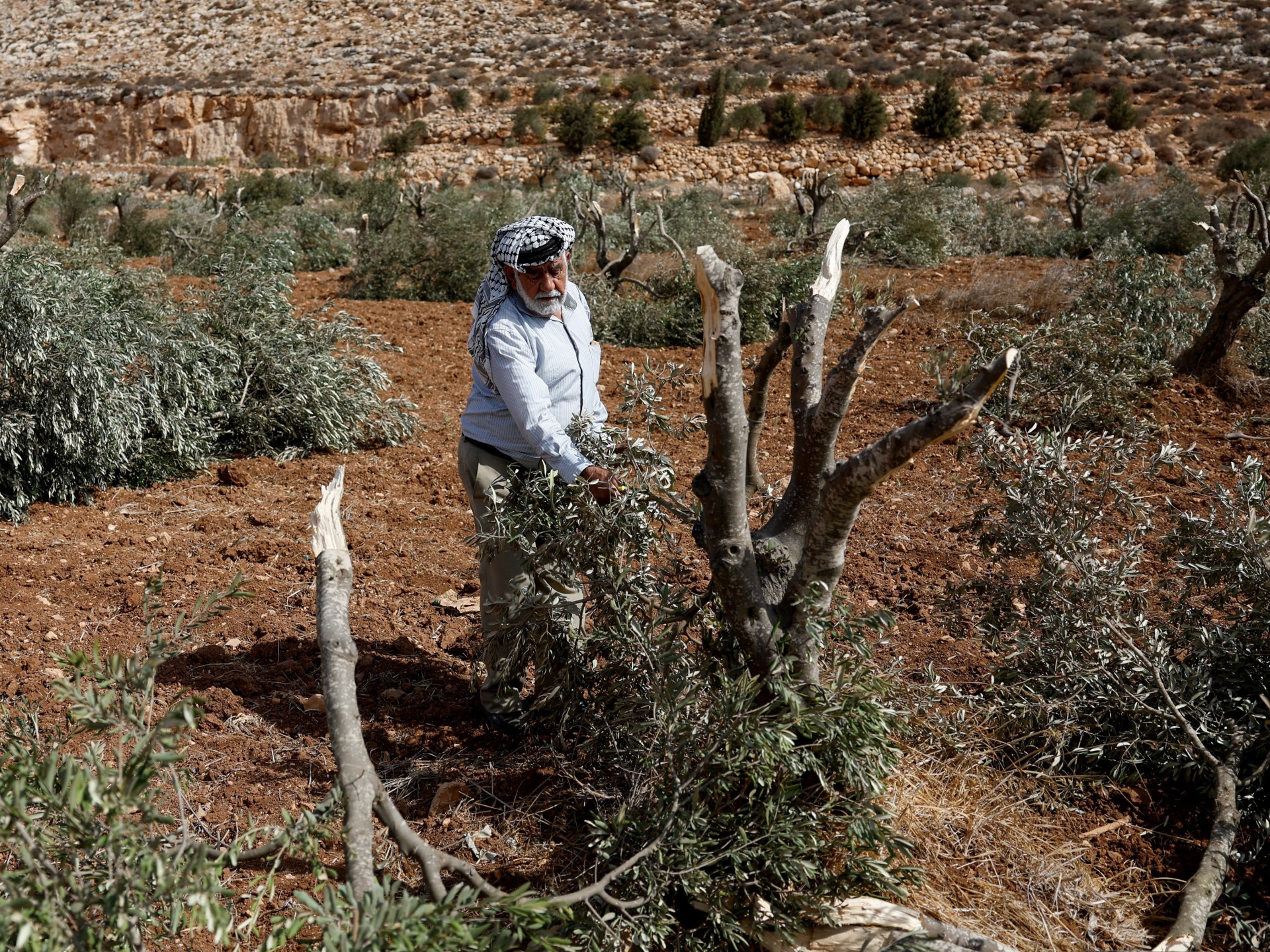
How do you explain to a child that the war ending in Gaza does not mean Palestinian families in the West Bank still can access their land to harvest olives? People still cannot reach their groves because of barriers set up by the Israeli military or they fear attacks by Israeli soldiers and settlers, or both.
There are daily violent assaults on Palestinian farmers and their land. Since October 7, 2023, there have been 7,154 attacks by Israeli settlers on Palestian people and property – some of them deadly.
Almost 1,000 Palestinians have been killed by the Israeli army and settler mobs, including 212 children; more than 10,000 Palestinians have been displaced. Settlers and soldiers have destroyed 37,237 olive trees since October 7, 2023.
Even life in urban areas has become unbearable.
As a resident of Rawabi, a city north of Ramallah, I, too, feel the suffocation of the occupation every day.
If I need to travel outside my city to run errands, shop, obtain official paperwork, or anything else, I could get stuck at a checkpoint for hours and never make it to my destination. There are four iron gates, a military tower, and a barrier between Rawabi and Ramallah; they can make the 10-minute trip between Rawabi and Ramallah last an eternity.
Throughout the West Bank, there are 916 Israeli barriers, barriers and iron gates, 243 of which were constructed after October 7, 2023. These open and close at the Israeli army’s whim, meaning a Palestinian can get stuck at one barrier for hours. This disrupts every aspect of life – from family visits to urgent medical care to school attendance and transportation of goods.
We have also been denied access to Jerusalem and thus our freedom of worship at Al-Aqsa Mosque and the Church of the Holy Sepulchre. Few Palestinians are given the special permits needed to enter the city. We last had access to Jerusalem more than 20 years ago. This means an entire generation of young people know nothing about the city except from the pictures and stories told by their parents and grandparents.
Even at night, the Palestinians are not left alone by the occupation. Any Palestinian home may be subject to a raid by the Israeli army, with soldiers breaking the front door, terrorising the family inside and detaining without charge some of its members. Neighbours would, too, be terrorised with Israeli soldiers firing tear gas canisters for no reason, just to cause more suffering.
The right to a normal life—to worship, to spend quality time with friends and family, to move freely, to access regular medical care and education —are all denied to the Palestinians in the West Bank.
The spectre of annexation
Over the decades since the occupation of 1967, Israel has managed to control almost half of the land of the West Bank. It has done so by constructing settlements and confiscating land from its Palestinian owners by declaring it either “state land” or “military zone”. The theft of Palestinian land accelerated after October 7; at least 12,300 acres (4,9787 hectares) were seized in two years.
In many cases, confiscated land is used to establish new settlement outposts or to expand existing settlements.
Settlement construction in the West Bank is not random. Rather, land is selected in a way that encircles Palestinian villages and towns, creating a settlement belt around them that prevents any form of geographical continuity between Palestinian territories, thus thwarting the dream of a future state.
To maintain these illegal settlements, Israel has also laid its hands on the West Bank’s natural resources. It has seized almost all water resources. This has ensured a massive water reservoir in the West Bank to serve the settlement expansion.
For the Palestinians, this has been disastrous. They are now almost completely dependent on Israeli water company “Mekorot”, which gives very small quotas of water to densely populated Palestinian areas, while settlers receive several times the Palestinian share per capita.
Every summer, when drought settles in, Palestinians are forced to buy extra water at exorbitant prices from Mekorot. Meanwhile, Palestinian wells and rain water tanks are often attacked and destroyed.
Since October 7, 2023, the Israeli government has accelerated its efforts to carry out annexation. We feel that the seizure of Area C – an area established by the Oslo Accords where Israel has full civilian and security control – is imminent. This would mean razing Palestinian villages and communities and expelling people towards Area A, which constitutes just 18 percent of the West Bank. Area B will follow. The process of forced expulsion has already started with Bedouin communities in the two areas.
This is our reality here in the West Bank. While peace conferences and meetings were held and peace in the Middle East is declared, we know nothing of it. Every day, every hour, every minute, we are harassed, intimidated, dispossessed and killed.
For decades, Israel has rejected political solutions and pursued a policy of controlling land, people, and resources. It has continued to wage war on us even when its bombardment has stopped. The only way to achieve true peace is to acknowledge the occupation and end it.
The views expressed in this article are the author’s own and do not necessarily reflect Al Jazeera’s editorial stance.
[ Peace News Desk ]