

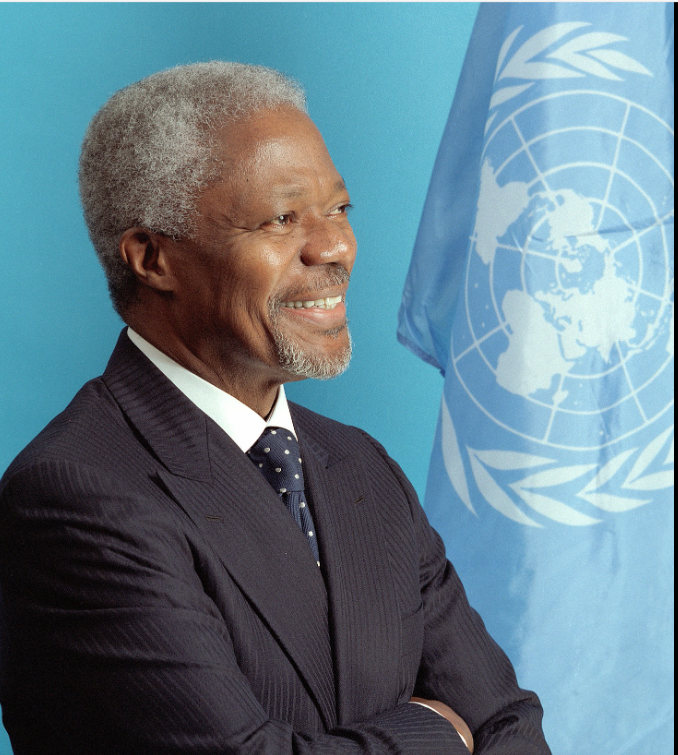
This Monday marks seven years since the world bid farewell to former UN Secretary-General Kofi Annan — a statesman remembered as a voice of wisdom, compassion, and peace.
Annan often reminded us of the strength in diversity, once saying in 2001:
“We can love what we are, without hating what—and who—we are not. We can thrive in our own tradition, even as we learn from others, and come to respect their teachings.”
His words continue to inspire a vision of unity built on respect and shared humanity. Today, and every day, we honor his memory and the ideals he stood for.
Kofi A. Annan of Ghana, the seventh Secretary-General of the United Nations, served from 1997 to 2006. He was the first Secretary-General to rise through the ranks of the UN staff itself.
During his tenure, Annan championed a bold reform agenda to revitalize the UN and strengthen its role in promoting peace, development, and human rights. He was a tireless advocate for the Millennium Development Goals, the rule of law, and Africa’s advancement, while also working to connect the UN more closely with civil society, the private sector, and people around the world.
At his initiative, UN peacekeeping was expanded and restructured to meet new global challenges. Under his leadership, Member States created the Peacebuilding Commission and the Human Rights Council in 2005. He was also central to the establishment of the Global Fund to fight AIDS, Tuberculosis and Malaria, the adoption of the UN’s first counter-terrorism strategy, and the global embrace of the principle of the “responsibility to protect” populations from genocide and mass atrocities. His 1999 “Global Compact” has since grown into the world’s largest platform for corporate social responsibility.
As a diplomat, Annan often placed himself at the heart of global crises. He helped guide Nigeria toward civilian rule (1998), eased tensions with Iraq over weapons inspections (1998), oversaw East Timor’s transition to independence (1999), and certified Israel’s withdrawal from Lebanon (2000). In 2006, he played a key role in ending hostilities between Israel and Hizbollah and mediated the Cameroon–Nigeria dispute over the Bakassi peninsula.
Annan also pushed for stronger accountability and transparency within the UN, introducing whistleblower protections, financial disclosure requirements, new technologies, and reforms to improve coordination at the country level.
Career and Education
Annan joined the UN system in 1962, beginning as a budget officer at the World Health Organization. Over the decades, he held posts with the UNHCR, the Economic Commission for Africa, the UN peacekeeping department, and as Special Representative to the former Yugoslavia. Just before becoming Secretary-General, he served as Under-Secretary-General for Peacekeeping.
He studied at the University of Science and Technology in Kumasi, Ghana, completed his degree in economics at Macalester College in Minnesota (1961), pursued graduate studies at the Institute of International Affairs in Geneva, and earned a Master of Science degree from MIT’s Sloan School of Management in 1972.
Honors
In 2001, Annan and the United Nations were jointly awarded the Nobel Peace Prize. He received many other international awards, honorary degrees, and distinctions throughout his life.
Personal Life
Born in Kumasi, Ghana, on 8 April 1938, Kofi Annan was fluent in English, French, and several African languages. He passed away on 18 August 2018 in Bern, Switzerland, at the age of 80, leaving behind a legacy of dignity, courage, and service to humanity.
-Peace News Desk