

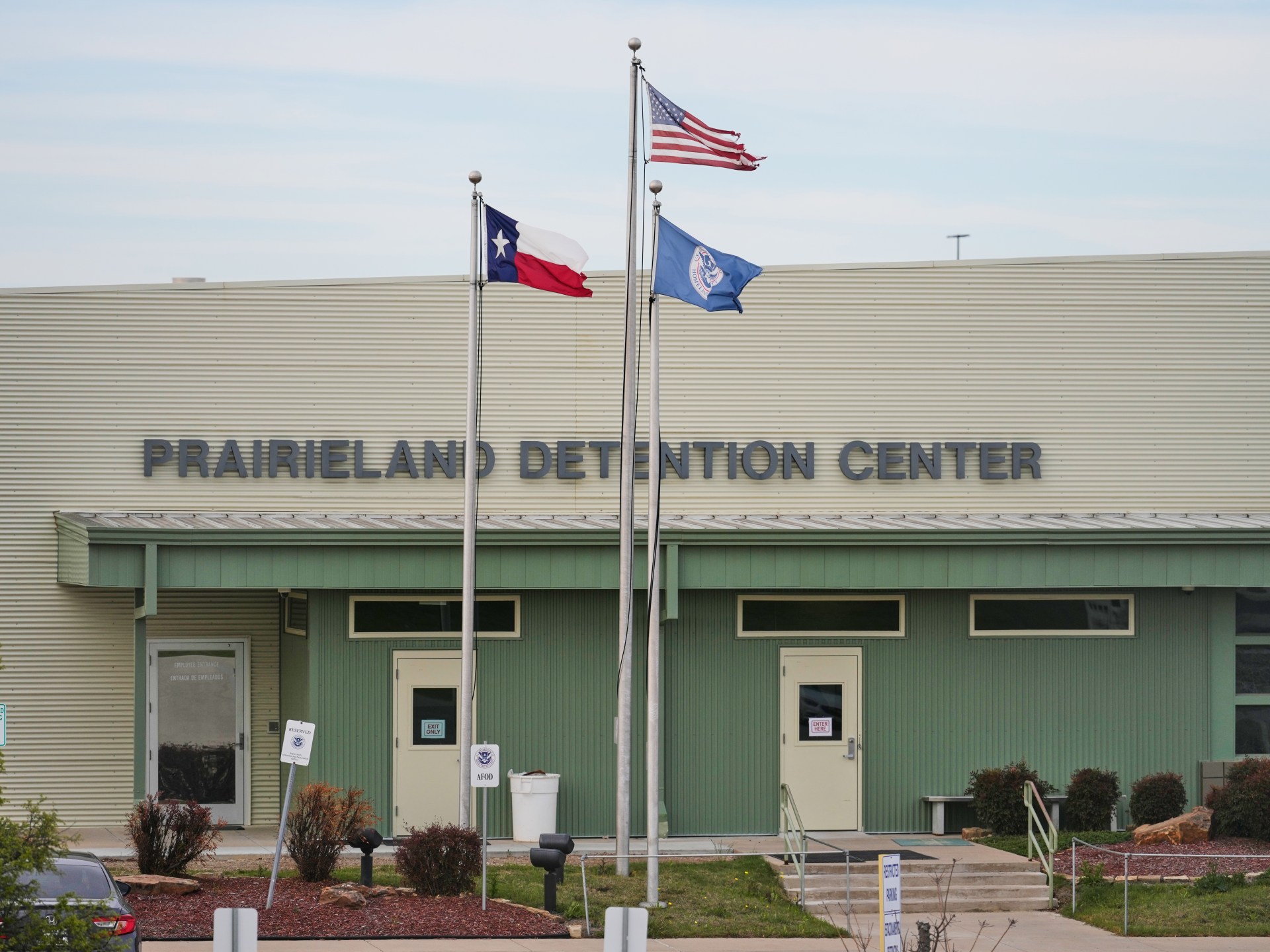
US prosecutors have alleged those involved in the Prairieland Detention Center protest were linked to antifa.
Seven more people have been sentenced to prison over a protest that culminated in a police officer being shot outside an immigration detention centre last year.
A federal court in Fort Worth handed down the latest sentences on Wednesday. Critics, however, say the case could reshape how protest is prosecuted in the United States.
Recommended Stories
list of 4 itemsend of list
The case centres on a shooting outside the Prairieland Detention Center, near Dallas, Texas, that took place during an antigovernment protest.
Six of the defendants in Wednesday’s sentencing hearing had pleaded guilty to providing material support to “terrorism” and received prison terms ranging from nearly two to 15 years.
A seventh defendant, Ines Soto, was sentenced to 50 years in prison after being convicted of “providing material support to terrorists”, as well as charges related to rioting and conspiracy to carry an explosive.
The protest in question took place on the night of July 4, 2025. Activists had gathered outside Prairieland to denounce President Donald Trump’s push for mass deportation. Some set off fireworks. Others have been accused of vandalism.
Prosecutors said that, during the demonstration, former US Marine reservist Benjamin Song shot and wounded a police officer who had just arrived at the centre. Song had reportedly shouted, “Get out the rifles,” prior to opening fire.
The Trump administration has described the protest as an act of “terrorism”, and 19 people were ultimately arrested.
Some of those detained were not present at the Prairieland protest. But the Trump administration has designated antifa — a loose-knit, left-wing antifascist movement — as a “domestic terrorist organisation”, and it accused the protest’s supporters of being part of an “antifa cell”.
Prosecutors for the US Department of Justice also argued that bringing firearms, first aid kits and body armour to the protest showed nefarious intent.
“The sentences handed down today make clear that Antifa terrorists who attack law enforcement and federal facilities will face swift and uncompromising justice,” acting Attorney General Todd Blanche said in a statement last week.
But civil liberties advocates say the case could have broad implications for protesters nationwide.
It will also likely test the boundaries of the free speech rights protected under the First Amendment of the US Constitution.
The Justice Department touted last week’s initial round of sentencing as the first time alleged antifa members were sentenced on criminal charges since Trump issued his executive order designating the group a “domestic terrorist” body.
Lawyers for the defendants, however, have largely denied links to antifa and rejected the prosecution’s characterisation of the protest.
They argued there was no planned ambush and that those carrying firearms only did so for their own protection, as is allowed under the Constitution’s Second Amendment. The fireworks, they added, were meant as a show of support for immigrants detained inside Prairieland.
On June 23, the eight defendants who chose to stand trial were handed lengthy prison terms.
Song was sentenced to 100 years in prison after being convicted of attempted murder in the shooting. The seven others received sentences ranging from 30 to 70 years. They received a combined 450 years in prison.
One defendant, Daniel Rolando Sanchez Estrada, has argued his only crime was to move a box of belongings, including zines. Prosecutors, meanwhile, have characterised his actions as “transporting a box containing numerous Antifa materials” and attempting to conceal them.
Several of the defendants, including Song and Sanchez Estrada, have filed notices of appeal.
In handing down last week’s sentences, US District Judge Reed O’Connor said what happened was not a protest but an “assault on democracy” and that “the need to deter this type of conduct is high”.
[ Peace News Desk ]