

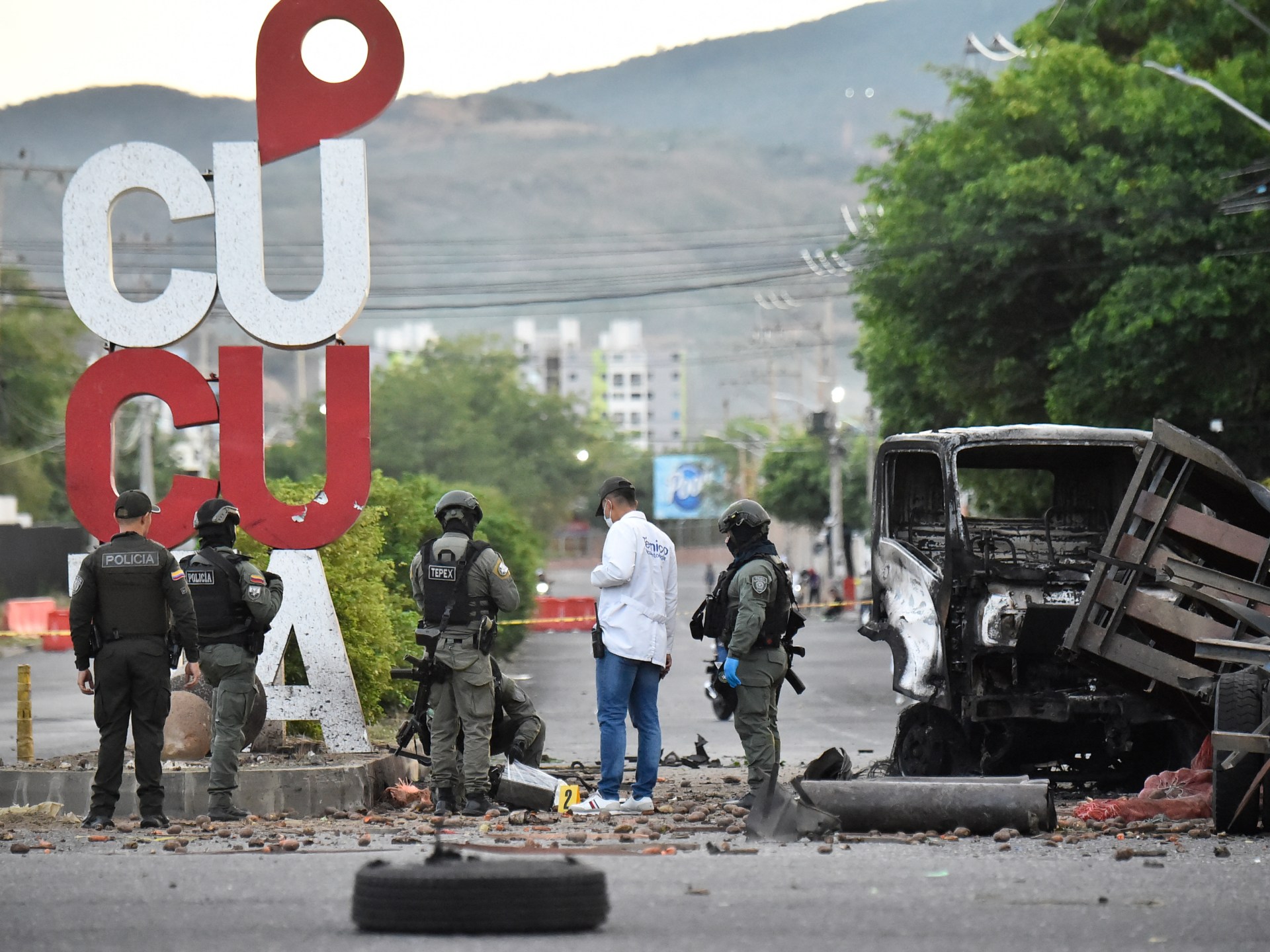
At least 11 people have been wounded in a Colombian car bombing, days before right-wing President-elect Abelardo de la Espriella is set to take office.
The detonation occurred in the city of Cucuta, which borders Venezuela, on Saturday, six days before de la Espriella is set to replace outgoing President Gustavo Petro, the country’s first left-wing leader.
Recommended Stories
list of 3 itemsend of list
“At this time, we have eight police officers and three civilians who have been injured,” George Quintero, the security secretary for the department of Norte de Santander, told reporters.
No groups immediately claimed responsibility for the attack. Several rebel groups, including the National Liberation Army (ELN) and dissident factions of the Revolutionary Armed Forces of Colombia (FARC), remain active in the area, as is the criminal group Clan del Golfo.
In a post on the social media platform X, de la Espriella said he condemned “in the strongest terms the cowardly terrorist attack carried out in Cucuta against our National Police”.
“Terrorism will not intimidate Colombia or break Colombians’ determination to live in peace and security,” he said.
For more than six decades, Colombia has grappled with an internal armed conflict, which has seen left-wing rebel groups, right-wing paramilitaries, government forces and criminal groups clash for power.
The conflict — and Colombia’s status as the top cocaine producer in the world — took centre stage in de la Espriella’s race to be president.
The election season was marred by political violence, as rebel groups were accused of staging dozens of attacks with bombs and explosive-laden drones.
In 2025, right-wing presidential hopeful and senator Miguel Uribe Turbay was shot in the head at an event in Bogota. He died a month later from his injuries.
His mother, journalist Diana Turbay, was famously killed as part of Colombia’s internal conflict in 1991, after she was kidnapped by criminal forces.
De la Espriella, who was set to take office on August 7, has promised to crack down on rebel groups and criminal organisations, both of which rely on the country’s cocaine trade.
The millionaire lawyer and businessman has never before held public office in Colombia.
But his right-wing campaign was backed by the administration of US President Donald Trump, who has clashed with the outgoing president, Petro, over matters of regional security.
Trump has advocated for a militaristic approach to criminal activity in the Americas, while framing drug traffickers as “narcoterrorists” who threaten US national security.
The election of de la Espriella represents a major ideological pivot from Petro, who has sought a peace-through-dialogue approach to resolve the armed conflict.
Petro also attempted to pivot away from the US-led “war on drugs” approach, focusing his government’s enforcement efforts on intercepting major drug routes.
He and Trump clashed over his decision to shift away from targeting impoverished, small-scale farmers who grow coca, the raw material for cocaine, as well as traditional Andean teas and medication.
By contrast, de la Espriella has pledged to further grow Colombia’s military alliance with the US.
He has also echoed hardline strategies championed by Trump and other right-wing figures like Salvadoran President Nayib Bukele, pledging to build megaprisons and bomb suspected drug traffickers.
“Any plane that takes off loaded with drugs — as commander-in-chief, I will order the Air Force to shoot it down,” de la Espriella told The Associated Press during his campaign.
“Any boat that sets out loaded with drugs, I will order it sunk with the people on board.”
The president-elect has long warned of an active assassination plot against him. He had initially sought to be sworn in at a military garrison in the conflict-hit department of Cauca. Petro did not authorise the plan.
He will instead be sworn in at the City Hall in Bogota, in a ceremony set to include 11,000 soldiers and police officers.
[ Peace News Desk ]