

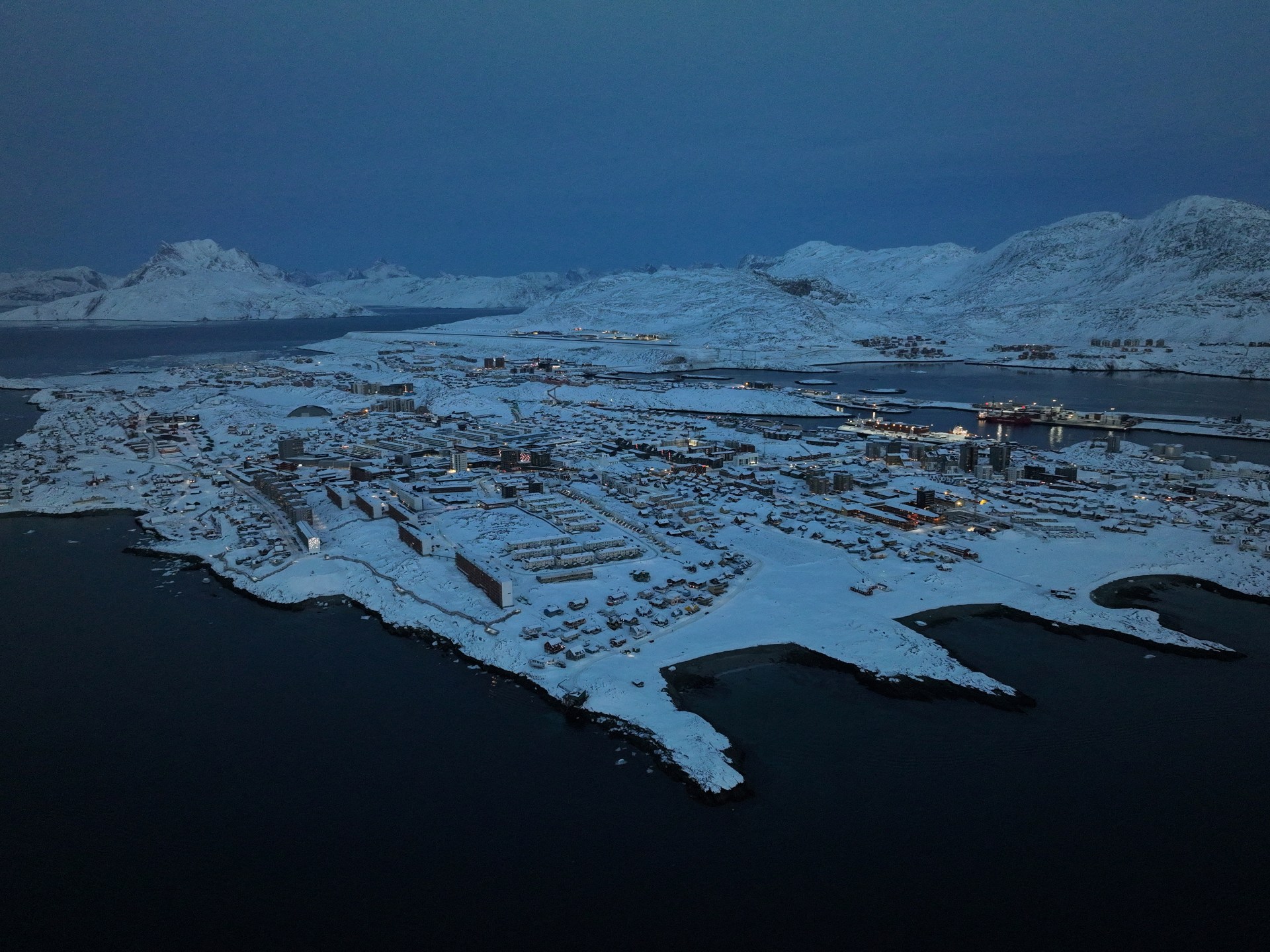
The new agreement between the United States, Denmark and Greenland on the security of the Danish autonomous territory appears to be good news. It may finally put an end to nearly two years of repeated intimidation of Greenlanders by Washington and ensure that the stated red lines on territorial integrity and sovereignty are not crossed.
We still do not know exactly what the agreement contains, but the emerging picture is close to a best-case scenario for Denmark and Greenland. The dispute appears to have been moved back onto the diplomatic playing field, where questions of international law, investment and security policy can be handled.
At the same time, US President Donald Trump can present himself as a winner to his supporters, which was necessary to de-escalate tensions. His political allies and aligned media outlets are already praising his negotiating strategy, arguing that sustained pressure worked and left the US better placed to expand its military presence in Greenland — an area that is, admittedly, vital to US national security.
But there is a catch: much of this was already possible under the existing 1951 defence agreement, which was updated in 2004 with Greenland’s Home Rule Government as a party. It gave the US extensive military rights, which Washington made considerable use of during the Cold War, when it maintained 17 military installations and more than 10,000 personnel in Greenland. Today, only Pituffik Space Base remains, with about 150 US military personnel.
There may be at least two changes introduced by the new agreement, if we are to take at face value Trump’s statement posted on Truth Social on September 19.
First, the US president wrote that the deal is an “‘Infinite Life’ Agreement, there is no end!” By comparison, the original agreement stated that it “shall remain in effect for the duration of the North Atlantic Treaty”. In other words, it was tied to NATO’s continued existence.
The new agreement may not be, which could be seen as a consequence of Trump’s limited commitment to NATO and his persistent insistence on “America First”.
Second, the US president wrote: “No U.S. adversary can EVER have a base in Greenland, have a military presence in Greenland, or make sensitive investments in Greenland without our express written approval.” In other words, the US would appear to have gained a formal veto power that could block adversarial countries – such as Russia and China – from seeking to establish a foothold in Greenland. Examples from recent years suggest, however, that this was already largely the case in practice.
The Danish government has intervened at least twice in cases involving Chinese interests in Greenland, where US security concerns were also at stake: in 2016, when a Chinese company showed interest in buying a decommissioned naval station at Kangilinnguit in southern Greenland, and two years later, when a Chinese construction company sought to take part in Greenland’s major airport project. Both were prevented.
With the new agreement in place, it appears that Danish intervention may no longer be formally necessary.
If this interpretation holds, the US has indeed increased its control over Greenland – on paper. In practice, the change appears to be relatively limited, which would be a testament to the negotiating skills of the Danish and Greenlandic representatives in the high-level working group. They have given Trump the opportunity to claim the victory he needed, while preserving sovereignty. It is perhaps a triumph of optics.
One sentence in Trump’s statement, however, should give us pause: “There will be NO COST to the United States”, he wrote. That is a rather remarkable piece of arithmetic, and one unlikely to reassure Danish taxpayers if it turns out to be true.
Still, we should remember that Mexico did not end up paying for the wall along its border with the US, and it remains to be seen whether Americans will receive the $5,000 Trump has promised if Republicans retain control of Congress in the midterm elections. We should also consider that Greenland could derive greater economic benefit from an expanded US military presence.
We can make a final pronouncement on the agreement only when we know in full what it actually says. Until then, there is at least some reason for cautious optimism and relief in both Nuuk and Copenhagen.
The views expressed in this article are the author’s own and do not necessarily reflect Al Jazeera’s editorial stance.
[ Peace News Desk ]