

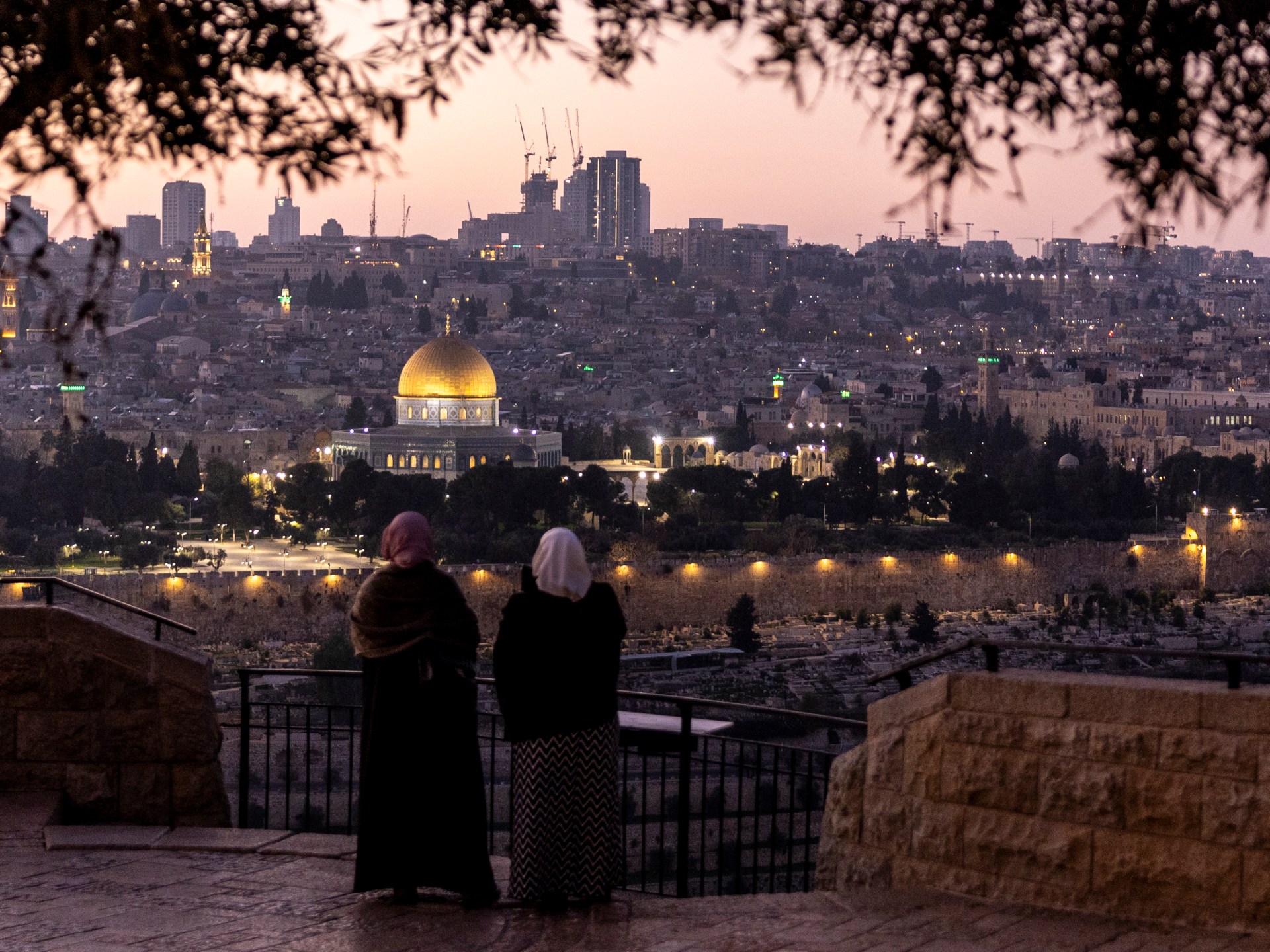
Israeli settlers have stormed the Al-Aqsa Mosque compound in occupied East Jerusalem again and performed Jewish prayers in the courtyard.
The weekend witnessed a series of provocative acts by Israeli politicians and settlers in the build-up to Yom Kippur, the holiest day in the Jewish calendar, and next month’s Israeli election.
Recommended Stories
list of 4 itemsend of list
On Thursday, National Security Minister Itamar Ben-Gvir and others again stormed the Al-Aqsa Mosque compound for Yom Kippur. Israeli Prime Minister Benjamin Netanyahu also visited a labyrinth of tunnels below occupied East Jerusalem on Saturday.
Early on Sunday morning, Netanyahu released videos and photographs on his official Instagram account documenting his participation in Jewish “Selichot” prayers at the Western Wall, known as the al-Buraq Wall to Muslims.
The tunnels lie underneath occupied East Jerusalem’s bustling Old City and the Al-Aqsa Mosque compound, making the incursions particularly sensitive for the occupied territory’s Palestinian population.
Translation: Happy New Year and a good final signature to all Israelis from the Western Wall.
Under the protection of security forces, Netanyahu, accompanied by several government ministers and thousands of Israeli settlers, made his way onto the plaza of the wall in occupied East Jerusalem on Saturday evening, ahead of Yom Kippur.
Footage shared by the prime minister showed him performing the rituals from behind bulletproof glass. In another video, Netanyahu and his wife, Sara, passed through one of the excavation tunnels running beneath the Western Wall while Jewish prayers took place.
“Well, we are in the tunnels at the al-Buraq Wall. It is moving to touch the rock of our existence. We are here very close to the Holy of Holies. We are here, and we will always remain here,” Netanyahu stated in the video.
Translation: Prime Minister Benjamin Netanyahu and his wife in prayer for the safety of Israeli soldiers tonight at the Western Wall.
Yom Kippur incursions
The prime minister’s subterranean visit unfolded alongside a wave of settler incursions into the holy site above ground.
On its official Facebook page, the Palestinian Jerusalem governorate reported that about 570 settlers had stormed the courtyards of the Al-Aqsa Mosque by 10am local time on Sunday. According to the governorate, the settlers performed Talmudic rituals and “epic prostrations” to mark Yom Kippur.
The Palestinian group Hamas strongly condemned the incursions in a press statement published on its official Telegram channel.
“The storming by Benjamin Netanyahu, against whom an arrest warrant has been issued by the International Criminal Court, of the tunnels and excavations beneath the blessed Al-Aqsa Mosque and the al-Buraq Wall, and the provocative statements and false claims accompanying it about the so-called Holy of Holies, represents a blatant attack on the identity of the Al-Aqsa Mosque and its status, and a provocation to the feelings of our Palestinian people and the Arab and Islamic nations,” the statement in Arabic said.
The group emphasised Al-Aqsa’s exclusively Islamic heritage and rejected Israel’s ongoing excavations under the holy site.
Religious or political?
Israel has been digging beneath occupied East Jerusalem for years, a move that has been condemned by archaeologists and the United Nations. The works are believed to be intended to find proof of the rampart wall of the Second Temple, but experts say there is no proof of this claim. Others view these measures as an attempt by Israel to cement its rule over occupied Palestinian land.
In 2022, Netanyahu led a cabinet meeting in the labyrinth, describing Israel as the “landlords of Jerusalem”. East Jerusalem has been earmarked as the capital of a future Palestinian state by Palestinians.
The timing of Saturday’s visit not only comes on the eve of Yom Kippur but also at a time of huge political significance for the Israeli leader, who trails in the polls against his rival Gadi Eisenkot, leader of the Yashar party.
Ahmed al-Hila, a political analyst specialising in Middle East affairs and the Arab-Israeli conflict, told Al Jazeera that Netanyahu is using religious symbolism to try to secure his political survival ahead of October’s general election.
“Benjamin Netanyahu wanted, through this visit … creating this symbolism for himself as a leader spearheading the right wing to consolidate the Israeli political and religious narrative in the Al-Aqsa Mosque, to attempt to gather the largest possible number of votes to serve as an electoral lever for him,” said al-Hila.
“As for the intense security mobilisation and Benjamin Netanyahu’s appearance behind a bulletproof glass shield [during a speech above ground], this is a direct indication that this city has not, up to this moment, submitted to Israeli security control, despite the repeated and frequent talk that Jerusalem is ‘the capital of the State of Israel’.”
The visit could also be a message to the wider world, amid global criticism of the controversial illegal settlement project E1, which the Israeli government has issued tenders for, and which appears designed to sever East Jerusalem from the occupied West Bank.
“What further confirms this conclusion is that initiating the settlement project called E1 does not only isolate the northern West Bank from its south … but this settlement project completes the isolation of the city of Jerusalem from its Palestinian surroundings,” Al-Hila said. “Therefore, this visit with its political symbolism confirms the idea of Israeli sovereignty over the city of Jerusalem.”
[ Peace News Desk ]